
RFID or RTLS in the Factory? It Depends on What You Need to Know
8 September 2026A practical guide to choosing based on the problem you want to solve
Picture two very common scenes.
You’re at the self-checkout in Decathlon or Zara: you set your items down and, in a few seconds, the system recognizes what’s in your basket. That’s the logic of RFID: understanding which objects are passing through a specific point.
Now picture a different situation. You’re about to leave the house, you’re already running late, and you can’t find your keys. You open the AirTag app to see where you left them. Here the question is different: you don’t need to know what the object is, you need to know where it is right now.
Similar situations happen in factories, just on a different scale.
Sometimes you need to identify thousands of components passing through a few mandatory checkpoints. Other times you need to know where orders, batches, bins, or equipment are as they move between departments.
This is where the real question comes in: when should you use RFID, and when should you use an RTLS?
RFID and RTLS are often compared as if they were alternative technologies. In reality, they usually answer different questions.
Picture a factory that works on a made-to-order basis. A production manager is looking for an order that no one can say for certain has reached a given stage. At the same time, the logistics manager wants to check that a pallet contains all the expected components.
The two situations look similar: both are about traceability. But the underlying question is different.
RFID: “What Passed Through Here?”
RTLS: “Where Is It Now?”
RFID: Knowing What Passed Through a Point
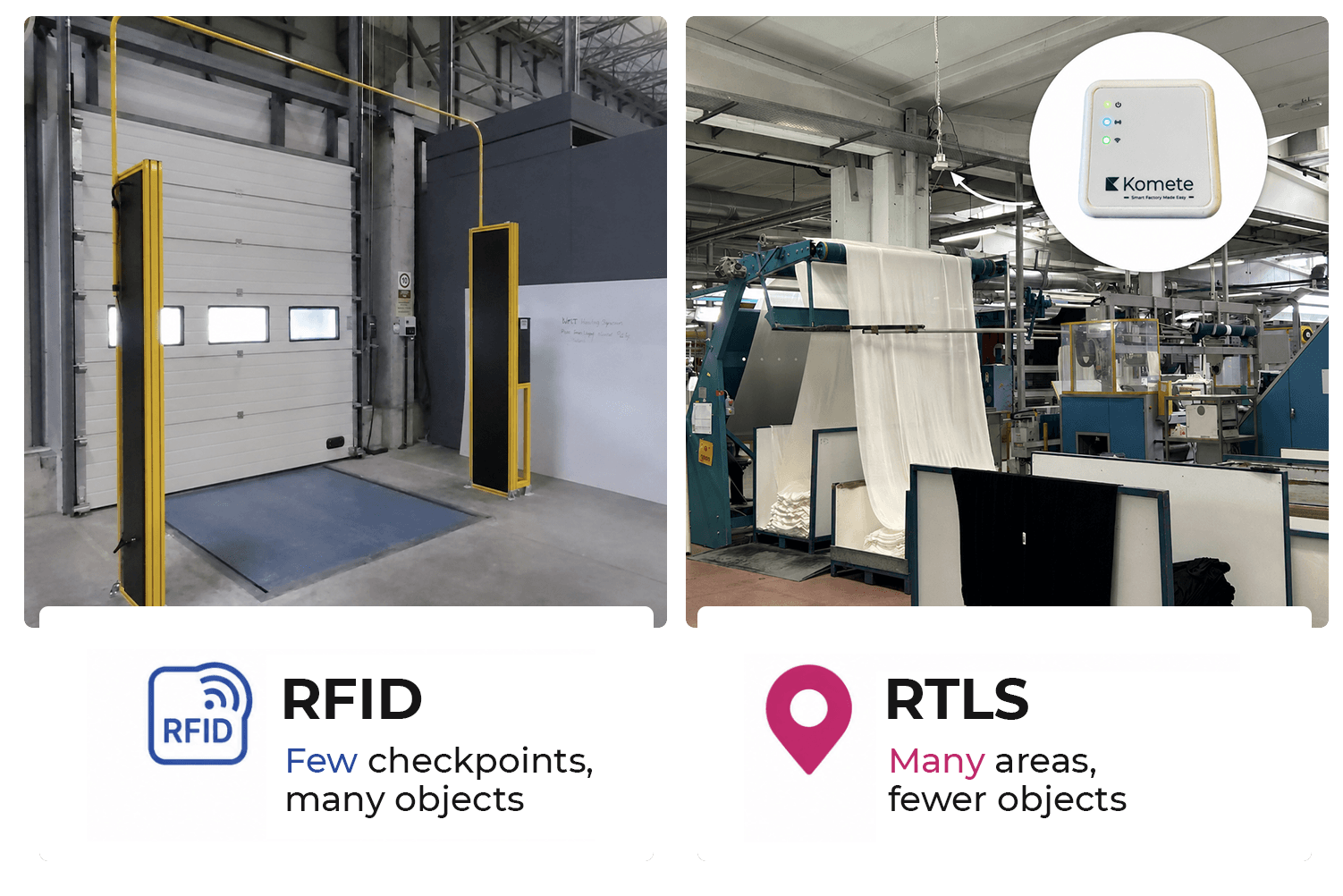
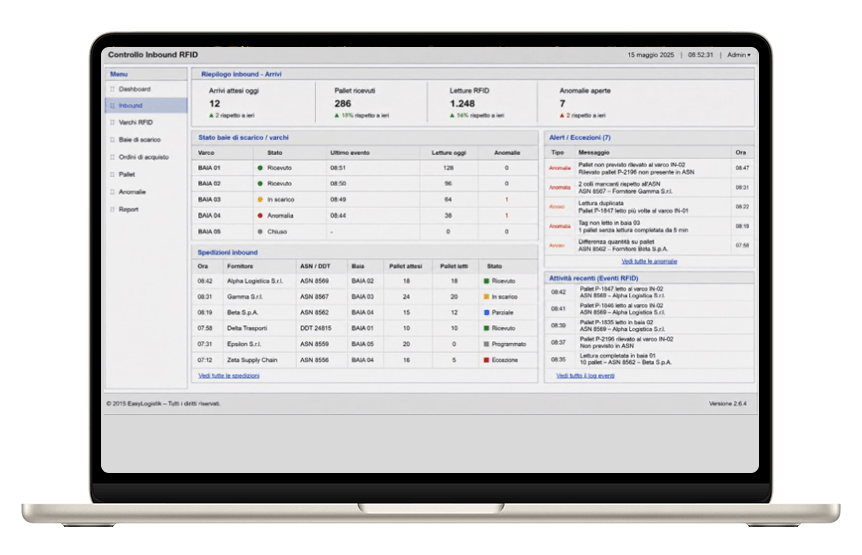
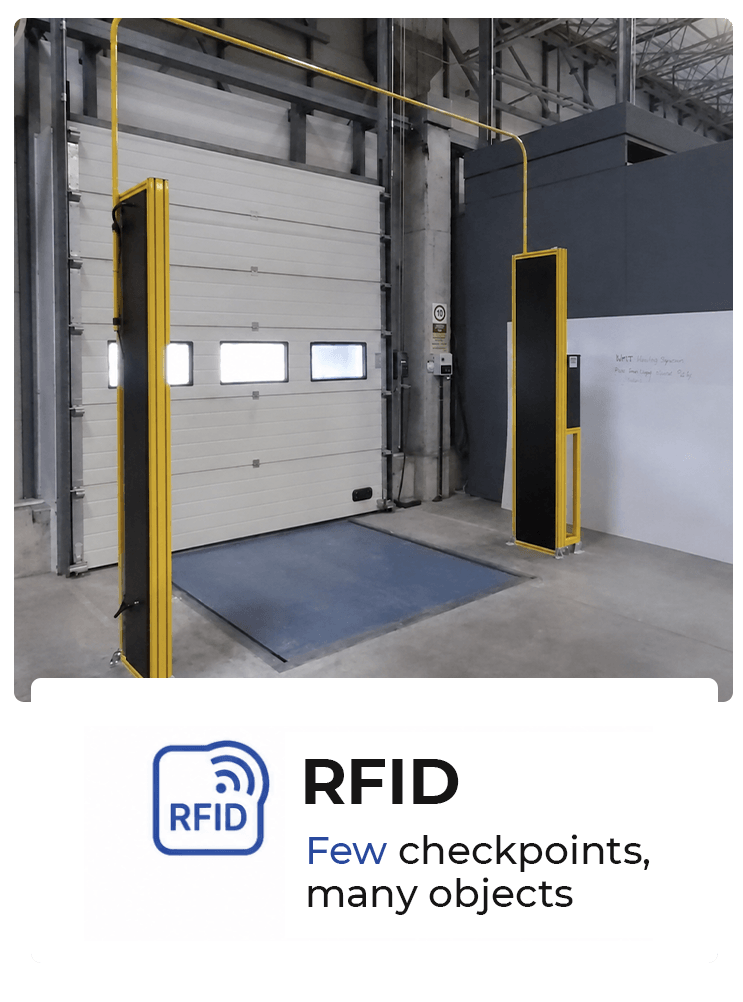
An RFID system automatically identifies an object as soon as it enters the reading range of an antenna. The most intuitive case is a checkpoint: a pallet passes through a doorway and the system automatically recognizes the tags on the material.
So the question RFID answers very well is: “What passed through here?”
This makes it especially useful when the flow passes through well defined points: goods receiving, shipping, entering or leaving a warehouse, checking the contents of a pallet, or verifying material at the production line.
The big advantage of passive RFID tags is their very low cost: they have no battery and can be applied to thousands or even tens of thousands of objects.
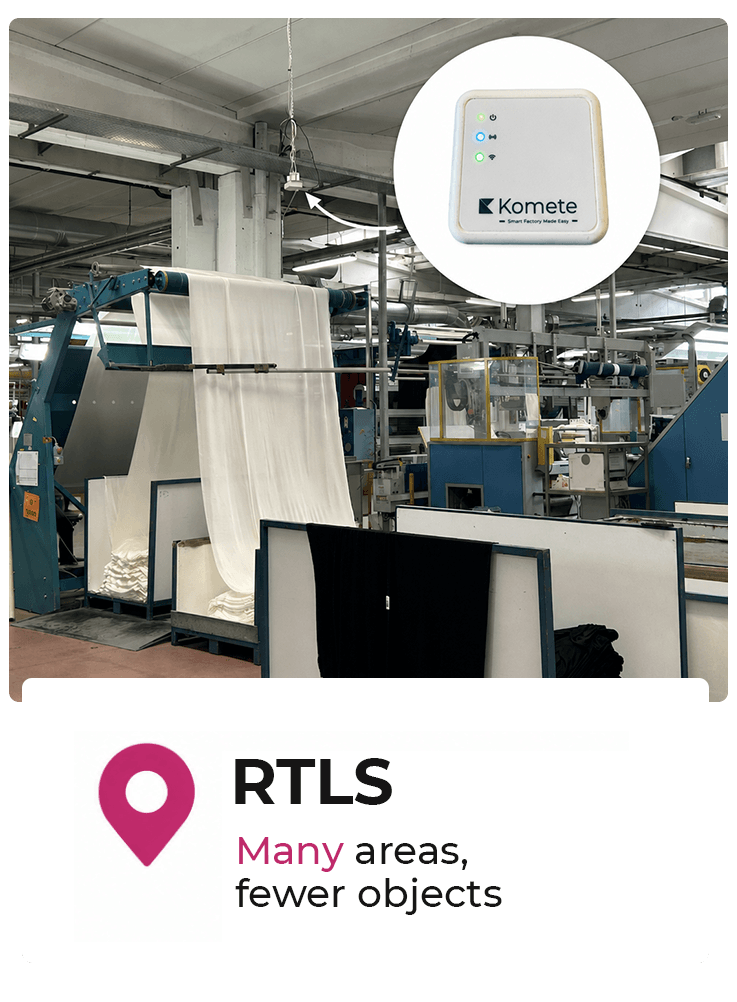
RTLS: Knowing Where Something Is Right Now
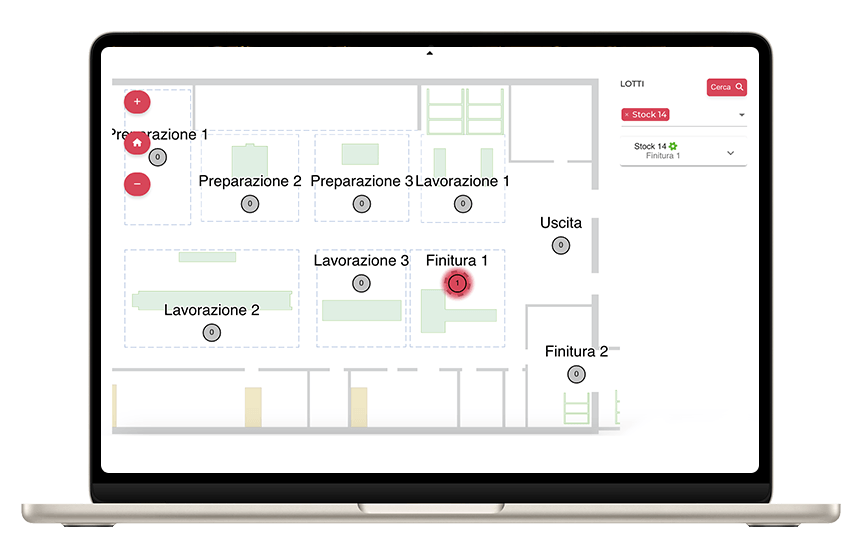
An RTLS, or Real Time Location System, starts from a different question: “Where is it right now?”
Instead of waiting for an object to pass through a specific point, the system detects its presence across the different areas of the plant. It can tell you, for example, that order 2487 has been in the grinding area for four hours, or that the batch you’re looking for is in the quality control area.
This becomes especially useful when material doesn’t always follow the same path, as often happens in made-to-order production: different routings, rework, outsourced processing, urgent jobs, and manual steps make it hard to cover every transition with a fixed checkpoint.
Where the Project Economics Really Change
RFID and RTLS spread out costs in almost opposite ways. It’s a very practical difference, because it often decides which architecture makes sense for a given plant.
The Cost Rule Worth Remembering
RFID: the passive tag costs very little, but reading gates and portals are more expensive and more complex to install. They require readers, antennas, cabling, and careful design of the reading point.
RTLS: the active tag costs more because it contains electronics and a battery, but the infrastructure can be much lighter, with inexpensive wireless gateways that can cover entire plants
So: many objects plus few mandatory checkpoints equals RFID. Fewer objects plus many positions to cover equals RTLS.
If you need to identify 20,000 components that all pass through two doorways, it makes sense to invest in those two reading points and put a cheap tag on every piece. But if you need to track 500 bins or carts that could be in any of thirty different areas, installing a portal at every possible passage quickly becomes complicated. It may be simpler to locate the bins directly.

What About Hybrid Solutions?
In some cases, RFID and RTLS work very well together. Individual components can be identified with RFID and linked to a kit. The kit can then be located during production.
This way, the system can know at the same time what’s in the kit and where the kit is. The same principle can be applied to bins, pallets, carts, or other reusable containers.
Imagine a company that manufactures components for the rail industry. Several kits of components are prepared to assemble a bogie.
An RTLS can track the kit through the various stages of production and tell you: “The kit for bogie 124 is in the assembly area.” RFID, on the other hand, can identify the individual components inside it: “This kit contains these eight valves, these four actuators, and these specific components.”
RTLS tells you where the kit is. RFID tells you what’s inside it.
So the two technologies aren’t necessarily alternatives. In some processes they can complement each other.
| Problem | Technology That’s Often the Better Fit |
|---|---|
| Knowing what arrived in the warehouse | RFID |
| Checking the components on a pallet | RFID |
| Checking material before shipping | RFID |
| Knowing where an order is | RTLS |
| Looking for a bin or a semi-finished part on the shop floor | RTLS |
| Reconstructing the actual path an order took | RTLS |
Why the Difference Matters Most in Made-to-Order Production
On a highly standardized line, material normally follows a predictable path. In high-mix, low-volume production, things change: different routings, outsourced processing, rework, manual steps, waiting time between departments, and priorities that shift throughout the day.
The ERP knows the planned cycle. The MES may know the last recorded update. But the question the operations manager asks at 3:30 pm is often still: “Where are the five urgent orders, really?”
When answering that question means calling the department supervisor, searching through Excel, or walking the shop floor, the problem is no longer simply about identification. It’s a problem of visibility into the physical flow.
So: RFID or RTLS?
You can start with three questions.
- Am I mainly interested in identifying many objects as they pass through a specific point? RFID is probably the first system to consider.
- Am I interested in knowing where orders, materials, or equipment are, even while they’re sitting between one stage and the next? An RTLS is worth considering.
- Do I need to identify a very large number of components that move together inside a small number of kits, bins, or vehicles? It could be worth combining the two technologies.
The right question isn’t “RFID or RTLS?” It’s “What information are we missing today to manage production better?”
Want to Understand Which Approach Makes Sense for Your Plant?
A layout plan and thirty minutes of discussion are often enough to figure out whether the problem is about checkpoints, position, or whether it makes sense to combine both approaches. The starting point isn’t choosing a tag. It’s understanding what data is missing today to make a better operational decision.